How AI Studios Maintain Character Consistency Across Episodes
A practical film-production method for keeping faces, wardrobe, locations and performances consistent across AI microdrama episodes.
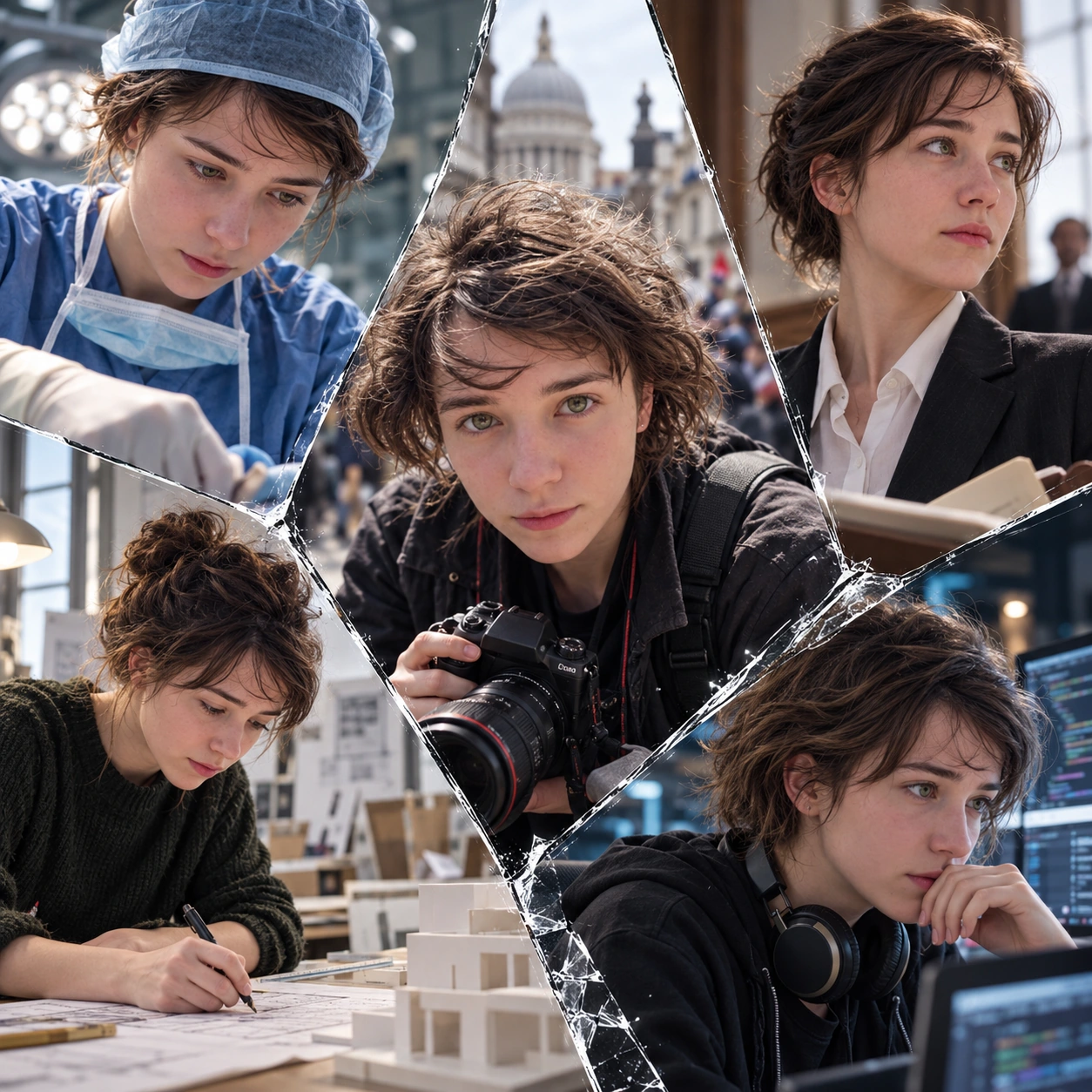
A practical film-production method for keeping faces, wardrobe, locations and performances consistent across AI microdrama episodes.
A character is not consistent because the prompt says “same person”
Character consistency in AI filmmaking means the audience recognizes the same believable person across every shot, episode and scene—without the face, body, wardrobe or behavior quietly changing. That sounds obvious until episode eight gives your protagonist a new jawline and your villain acquires an unexplained extra ring. Apparently the costume department has entered witness protection.
One reference image may be enough for a portrait test. It is not a dependable production system for an episodic story with close-ups, profiles, action, different lighting and expressions. Consistency is a combined problem of character design, spatial continuity, movement, editorial judgment and human approval.
A viewer forgives a stylized world if its rules are coherent. They are much less forgiving when the lead's eyes move to a different face between a confession and the reverse shot.
Build a character bible before generation
Start with approved front and profile portraits, facial proportions, skin texture, hairline, age cues, height, body proportions and expression references. Include wardrobe construction, accessories, tattoos and any feature the story cannot afford to forget. Define emotional ranges: restrained anger is not interchangeable with a generic stock-photo smile.
Keep versions controlled. Name every approved reference, and reject unapproved substitutions. A fresh character reference generated halfway through the show may look better in isolation yet be disastrous for continuity.
- Face: neutral, 90-degree profile, three-quarter and expressive close-ups
- Body: height and proportions against a scale reference
- Wardrobe: front, side and back views for repeated outfits
- Performance: micro-expressions, blink behavior, posture and hand habits
- Continuity: signature jewelry, injuries, makeup, aging and scene-specific changes
Call it a character bible, a look library or a digital casting dossier. The name matters less than making it the one approved source of truth.
Control the scene, not only the portrait
Imagine an argument in a dining room. The actors must relate to the same table, window, practical light and camera axis, even across separate generations. If the environment resets every time, a face can remain identical while the scene feels fake.
That is why 3D blocking and fixed spatial references matter. Place the table, doors, windows, props and character positions in a scene plan before generating the expensive shots. Use the blocked layout to inform lens height, eyelines, directions of movement and shot-to-shot geometry. It is not a guarantee that a model will obey every millimeter. It is a much better starting point than asking the model to remember an entire set in a paragraph.
For Sinfluent Media's studio-developed workflow, client-supplied assets can be placed within this blocked environment. Separate character-reference and animation passes give the team a repeatable basis for face shape and movement. The studio then checks and fixes drift through regeneration, compositing, editing or conventional VFX as appropriate.
A practical consistency test across five shots
Before approving the pilot, run the same lead through a controlled sequence: a neutral close-up, a three-quarter turn, a profile while speaking, a moving medium shot and a wide shot with a prop. Look for stable face width, eyelids, ears, silhouette, costume folds, lighting and eye direction. Repeat under a second lighting setup.
Do not rely on the first frame. Watch the entire moving shot at normal speed, then review the most difficult moments frame by frame. Repeatedly regenerating everything is an expensive way to create new problems. Triage: some errors need a regenerated shot; others need a compositing correction, edit, crop or refined motion pass.
Once the tests pass, approve an episode-level visual bible, not just a gallery of attractive stills. This is where production shifts from “can we make her?” to “can we direct her?”
Keep editorial continuity and sound in the loop
Human recognition is remarkably good at detecting inconsistent acting. If a character is grieving in one shot and inexplicably delighted in the next, perfect facial geometry will not rescue the scene. Directors need performance notes, matched eyelines, reaction shots, speech rhythm, believable voice and sound continuity.
At Sinfluent, the principle is to approve the dramatic intention first and use AI as production technology, not as the director. That means storyboards, character and environment sign-off, planned beats, quality-control checkpoints and final editing. For long-run microdrama, this workflow is also a budget tool: reusable approved assets reduce repeated discovery work. This continuity planning is fundamental to commissioned AI microdrama production.
Character consistency is not a cosmetic bonus. It is part of audience trust, and audience trust is what keeps a serial narrative alive past its first dramatic cliffhanger. For practical budgeting implications, read our production cost guide.
Quick Questions, Straight Answers
Will one character reference image prevent every face change?
No. A locked reference set, planned shots, spatial blocking, controlled lighting and human review reduce drift but do not eliminate every failure.
What should a client approve before episode one?
A character bible, front/profile views, expression range, wardrobe, key locations, camera language and representative motion tests.
How can the same actor look consistent across markets?
Treat localization as a controlled remake: align performance timing, continuity references, voice and lip movement instead of regenerating scenes independently.